OpenClaw vs Manus: Two Very Different Paths to AI Agents

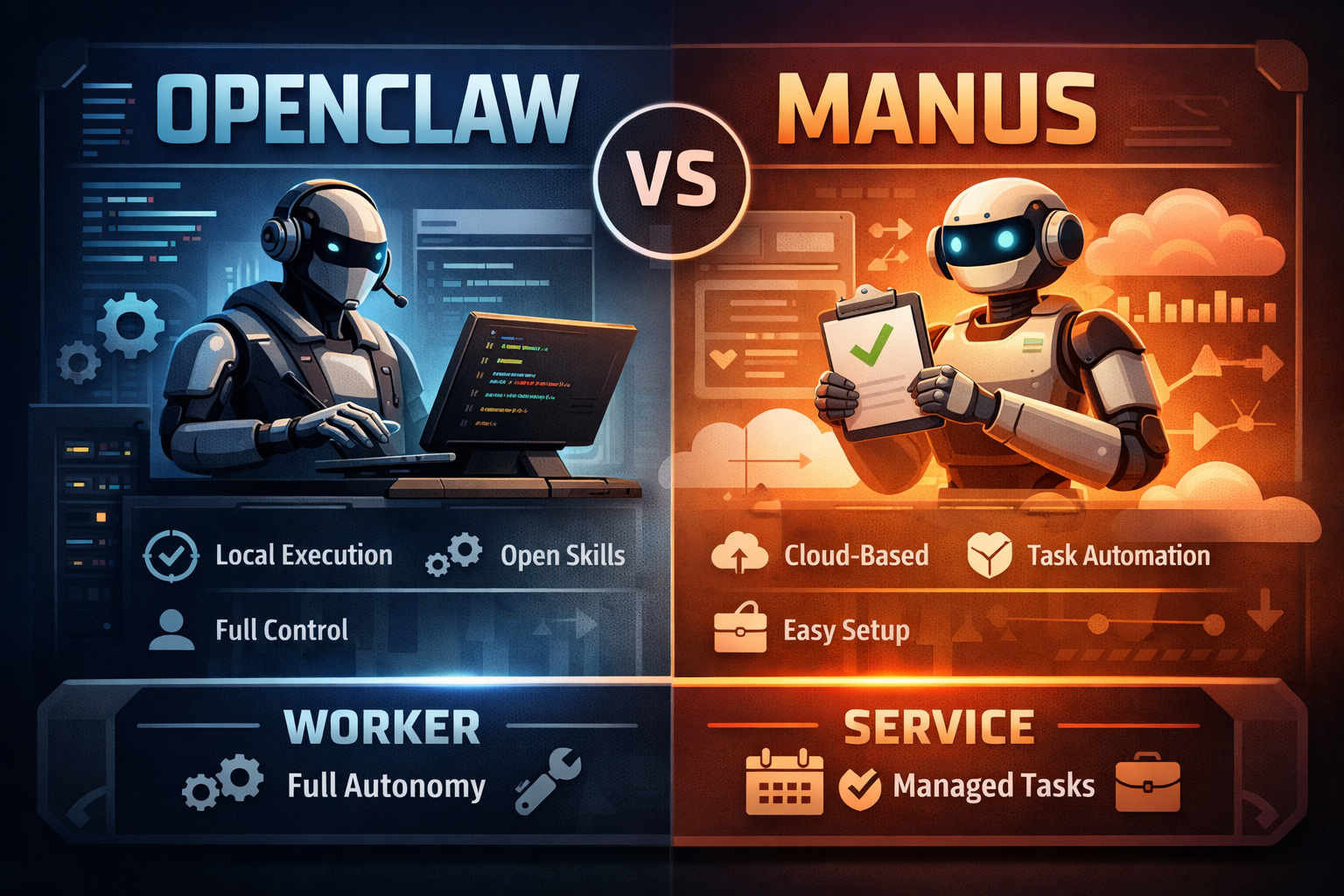
As AI agents move from demos to real work, two names keep showing up in technical and founder conversations: OpenClaw and Manus.
They’re often mentioned together—but they solve very different problems.
This article breaks down OpenClaw vs Manus across philosophy, architecture, use cases, and who should use what—without marketing fluff.
Where TopSalesAgent Fits In
TopSalesAgent sits between the raw power of OpenClaw and the convenience of Manus—but with a clear focus on revenue outcomes. Instead of asking users to build skills (like OpenClaw) or relying on opaque, general-purpose task execution (like Manus), TopSalesAgent packages autonomy into a production-ready AI sales worker. It comes pre-trained on outbound, inbound, objection handling, and meeting qualification—so founders and SMBs get a true “AI sales rep” that executes end-to-end without engineering overhead. In short: OpenClaw is for building agents, Manus is for delegating tasks, and TopSalesAgent is for closing deals.
What Is OpenClaw?
OpenClaw is an open-source agent runtime designed to run locally and operate like a real autonomous worker.
Its core idea is simple but radical:
The model is the brain.
Skills are the hands and feet.
Instead of treating an AI as a chat interface, OpenClaw treats it as an executor:
It installs skills
Calls tools via CLI
Reads and writes files
Runs code
Chains actions without constant human prompting
This makes OpenClaw ideal for developers and power users who want agents that actually do things, not just talk.
Key Characteristics of OpenClaw
Runs locally (privacy-first)
Open skill system
CLI-driven execution
Highly composable
Minimal abstraction between agent and system
Think of OpenClaw as a bare-metal OS for AI agents.
What Is Manus?
Manus takes almost the opposite approach.
Manus is a productized, cloud-based AI agent platform focused on outcomes, not internals. You don’t manage skills, environments, or execution logic—instead, you describe goals and let the system handle the rest.
Manus is designed for:
Non-technical users
Business workflows
Rapid task completion
Low setup friction
Where OpenClaw feels like hiring an engineer, Manus feels like hiring a managed assistant service.
Key Characteristics of Manus
Cloud-hosted
Closed execution layer
Task-first UX
Opinionated workflows
Minimal configuration
Manus optimizes for speed and accessibility, not extensibility.
OpenClaw vs Manus: Architecture Comparison
Dimension | OpenClaw | Manus |
|---|---|---|
Deployment | Local / self-hosted | Cloud |
Control | Full | Abstracted |
Extensibility | Skill-based | Platform-defined |
Target User | Developers, builders | Founders, operators |
Transparency | High | Low |
Autonomy Style | System-level | Task-level |
This architectural difference drives everything else.
Autonomy: Real Execution vs Managed Tasks
This is the most important distinction.
OpenClaw Autonomy
OpenClaw agents:
Decide how to solve problems
Install dependencies
Modify environments
Execute multi-step plans
They feel like junior engineers who need direction but not micromanagement.
Manus Autonomy
Manus agents:
Optimize for task completion
Operate within predefined boundaries
Abstract away execution logic
They feel like outsourced operators—fast, reliable, but boxed in.
Skills vs Prompts
OpenClaw is skill-native.
A skill is not just a prompt—it’s an executable capability. Once installed, the agent can reuse it across tasks without re-prompting.
Manus is prompt-and-go:
You describe what you want
The system translates it internally
You don’t see or manage the underlying mechanics
This makes Manus easier to start with, but harder to customize deeply.
Privacy and Data Control
If data sensitivity matters, this alone can decide the winner.
OpenClaw:
Runs locally. Your code, files, and data never leave your machine unless you decide.Manus:
Cloud execution. Great convenience, but you trade off visibility and control.
For regulated industries or internal tooling, OpenClaw is often the safer bet.
Who Should Use OpenClaw?
OpenClaw is best if you:
Build developer tools
Want agent factories or reusable agents
Need deep customization
Care about execution transparency
Are comfortable with CLI and systems thinking
It shines when agents are infrastructure, not features.
Who Should Use Manus?
Manus is ideal if you:
Want fast results
Don’t want to manage environments
Need business workflows done now
Prefer UX over flexibility
Are non-technical or time-constrained
It excels as a service, not a framework.
The Bigger Picture: Tools vs Workers
The real difference between OpenClaw and Manus isn’t technical—it’s philosophical.
OpenClaw treats AI as a worker you equip.
Manus treats AI as a service you consume.
Neither is “better.”
They exist for different stages and different users.
Final Take
If you’re asking:
“What can this agent actually do on my system?”
You’re thinking OpenClaw.
If you’re asking:
“How fast can I get this task done?”
You’re thinking Manus.
And that distinction is likely how the AI agent ecosystem will split going forward.
